ADF7021 radio board for the Raspberry Pi
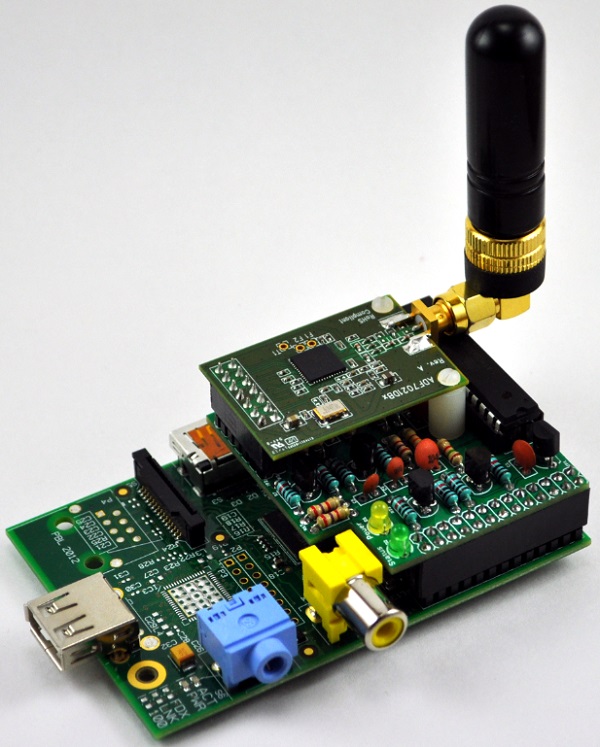
A very inexpensive D-Star hotspot for the Pi can be built using a radio module from Analog Devices and a simple interface board. This project was just an experiment and there are no plans to offer boards or kits for sale.Because the frequency chosen by Analog Devices for the onboard crystal is not optimized for D-Star, the standard 4800bps is slightly off. In practice this means that the newer ICOM radios like the ID-31, ID-51, ID-5100 and ID-7100 are going to have trouble receiving. Any of the older ICOM radios such as the 91AD, 92AD, 80AD, 800H, 880H, 2820, U82, V82 and 2200 seem to work well. Using a mobile radio is not a great idea because the lowest power setting may overload the 7021 receiver and require an attenuator. Changing out the tiny surface mount crystal on the radio module to a 14.7456MHz version and updating the 7021 initialization values should make it work well for the newer ICOM radios.
Project genesis
The original idea for the project was based on some messages posted by Satoshi Yasuda 7M3TJZ/AD6GZ, perhaps as far back as 2006 or 2007. He briefly mentioned doing some simple tests with 7021 chip/evaluation module and was able to receive DStar data. There is also a brief mention of the Moe Wheatly AE4JY Digital Voice Transceiver (DVX) Project back in 2007 which also uses the 7021 chip.Sample DV Stream received by ADF7021
Japanese forum discussion (Google translation)
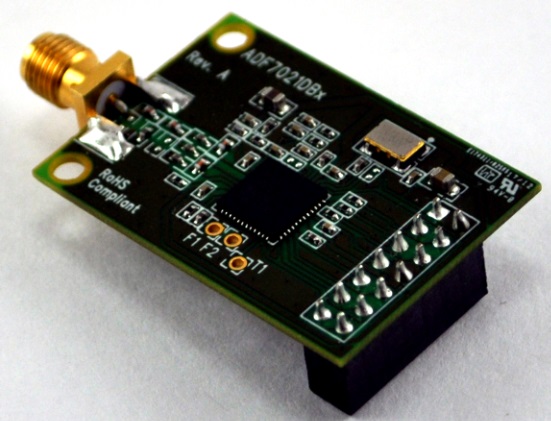
ADF7021 evaluation module
The Analog Devices' ADF7021 device is the chip used in the DV Access Point Dongle (DVAP).Analog Devices produces a number of evaluation modules for the 7021 chip. These modules are available from many electronic part suppliers such as Mouser and Digikey. The list price is $50.40.
The D-Star experiments were done with the DBZ3 model which is configured for 431MHz-470MHz.
2013-2014 project brought back to life
Fast forward to 2013. There has been some fantastic Work done by Guus van Dooren PE1PLM with his DVMega project to produce a simple prototype AND the necessary firmware.
Jonathan Naylor's D-Star Repeater software supports the new ADF7021 projects staring with the 20140117 beta release. "Added the DVMEGA hardware. Speaking of new hardware, Guus PE1PLM is working on some new hardware which sounds very exciting, I am happy to include explicit support for it within my software. This is the first version so it is possible that more changes will be made, but feedback has been good so far."
Adapter board
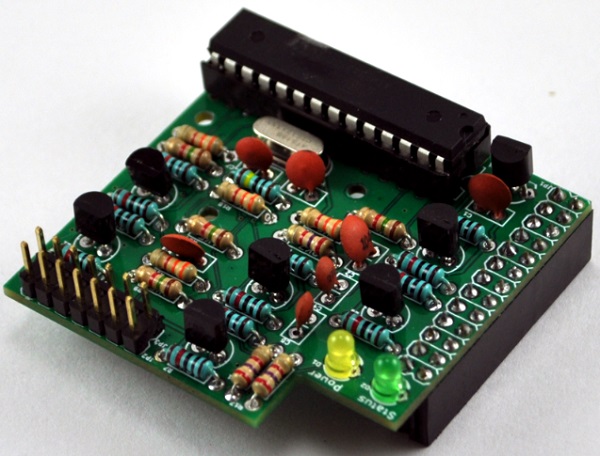
The ADF7021 evaluation board is designed to operate at 3.3V, the same voltage level used on the Pi GPIO pins. Since the GPIO pins on the Pi are not fast enough to handle communicating with the eval board, a microcontroller such as the ATmega328 chip is needed. The ATmega328 chip needs to run at 5V so much of the circuitry on the adapter board is dedicated to shifting the signal voltage levels from 3.3v to 5v to 3.3v again.An adapter board was designed to plug directly into the Pi and includes the Atmga328 chip to act like an Arduino UNO. The adapter board presents a standard serial interface to the Pi connector so the software thinks it is talking to a standard device over a serial port.
Firmware
The links to the firmware files can be found on the downloads page.The easiest way to program the ATmega328 chip is to use the one on an Arduino UNO board. Since the UNO board already comes with the bootloader installed, it is easy to use the Arudino tools to program the firmware. Then the chip just needs to be moved from the UNO to the adapter board.
The hardware design of the adapter board includes a connection to a GPIO pin to simulate the Arduino programming RESET pin. See the instructions here to configure the Pi to use the Arduino environment natively on the Pi.
Software
The G4KLX DStar Repeater software already has the changes needed to support the 7021 based boards. Us the configuration examples here to set up the modem settings.Operation
As long as there is 5V supplied by the Pi, the Power LED will be on. The Status LED will turn on whenever the firmware is transmitting OR receiving an audio stream. It should remain off when the board is in listening mode.Schematic
The schematic diagram and PCB layout was done using Eagle CAD. They offer a limited free version of the software available for Windows, Mac and Linux. The PDF of the schematic diagram and links to the Eagle files can be found on the downloads page.Bill of Materials
For the most part, all the parts are available from either Mouser and/or Tayda Electronics. The PCBs can come from a service such as OSH Park or Seeed Studio.The prices below are based on purchasing enough parts in bulk to make kits for at least 10 boards. Buying the parts for just a single board would cost quite a few dollars more. The pricing for the resistors and capacitors is based on buying at least multiples of 100 at a time. The pricing for parts at Tayda assumes using 15% discount they regularly post on their Facebook page.| Category | Description | Rev 0.2 designator | Qty | Price | Ext | Vendor link |
|---|---|---|---|---|---|---|
| Semiconductors | ||||||
| MCP1700-3302E/TO | IC1 | 1 | $0.370 | $0.370 | Mouser | |
| BS108ZL1G | Q1, Q2, Q3, Q4, Q5, Q6 | 6 | $0.345 | $2.070 | Mouser | |
| ATMEGA328P-PU | U1 | 1 | $2.940 | $2.940 | Mouser | |
| EVAL-ADF7021DBZ3 | JP1, JP2 | 1 | $54.400 | $54.400 | Mouser | |
| LEDs | ||||||
| LED Yellow | D1 | 1 | $0.017 | $0.017 | Tayda | |
| LED Green | D2 | 1 | $0.017 | $0.017 | Tayda | |
| Crystals | ||||||
| 16.000MHz | Y1 | 1 | $0.085 | $0.085 | Tayda | |
| Capacitors | ||||||
| 30p (30) | C6, C7 | 2 | $0.008 | $0.016 | Tayda | |
| 27n (273) | C4, C5 | 2 | $0.008 | $0.016 | Tayda | |
| .1u (104) | C1, C3 | 2 | $0.008 | $0.016 | Tayda | |
| 1u (105) | C2 | 1 | $0.088 | $0.088 | Mouser | |
| Resistors | ||||||
| 1.5K | R4, R9, R14, R21 | 4 | $0.009 | $0.036 | Tayda | |
| 2.7K | R1, R6, R17 | 3 | $0.009 | $0.027 | Tayda | |
| 3.3K | R5, R12, R18, R22 | 4 | $0.009 | $0.036 | Tayda | |
| 10K | R2, R3, R7, R8, R10, R11, R15, R16, R19, R20, R23, R24 | 12 | $0.009 | $0.108 | Tayda | |
| 1M | R13 | 1 | $0.009 | $0.009 | Tayda | |
| Connectors | ||||||
| 2x7 conn | JP1, JP2 | 1 | $0.042 | $0.042 | Tayda | |
| 2x13 conn | JP1 | 1 | $0.130 | $0.130 | Tayda | |
| 28 pin DIP socket | U1 | 1 | $0.094 | $0.094 | Tayda | |
| PCB | ||||||
| 2 sided PCB | 1 | $0.825 | $0.825 | Seeed Studio | ||
| 2 sided PCB - Qty 3 | 1 | $6.067 | $6.067 | OSHPark | ||
| Shipping | ||||||
| Mouser | 1 | $0.675 | $0.680 | |||
| Seeed | 1 | $1.000 | $1.000 | |||
| Tayda | 1 | $0.280 | $0.280 | |||
| Total without radio | $8.902 | |||||
| Total with radio | $63.302 |